Improving youth access to substance use support in rural B.C.
| Project Type | Academic (final project for Advanced Human-Computer Interaction course) |
|---|---|
| My Role | Product Design, Visual Direction, Prototyping, Design System |
| Team | Jae Eun, Kate, Frentzen |
| Timeline | Oct–Dec 2025 |
Overview
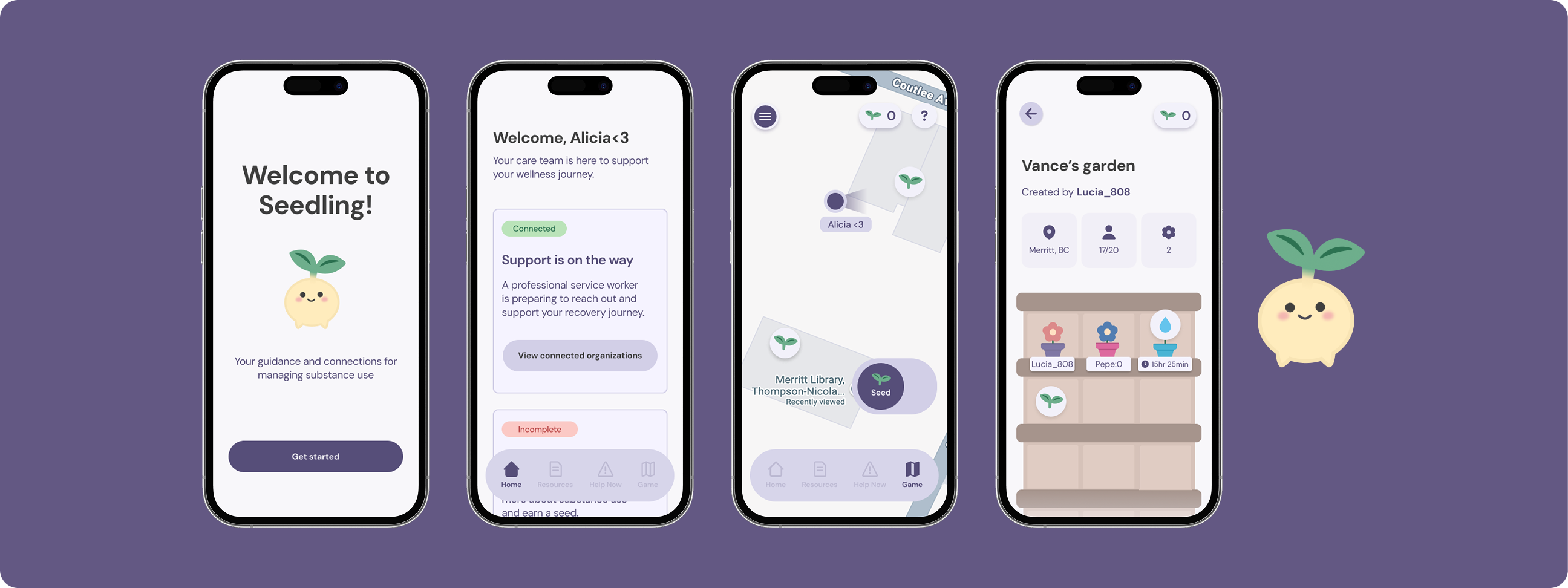
Seedling is an app designed to support rural youth (13–24 y.o.) in British Columbia (BC) struggling with substance use. The app reduces barriers to accessing social services by enabling outreach to service providers and offering a gamified experience that keeps users engaged while waiting for follow-up.
The final deliverable is an interactive prototype demonstrating core user flows, including onboarding, service connection, and a location-based game.
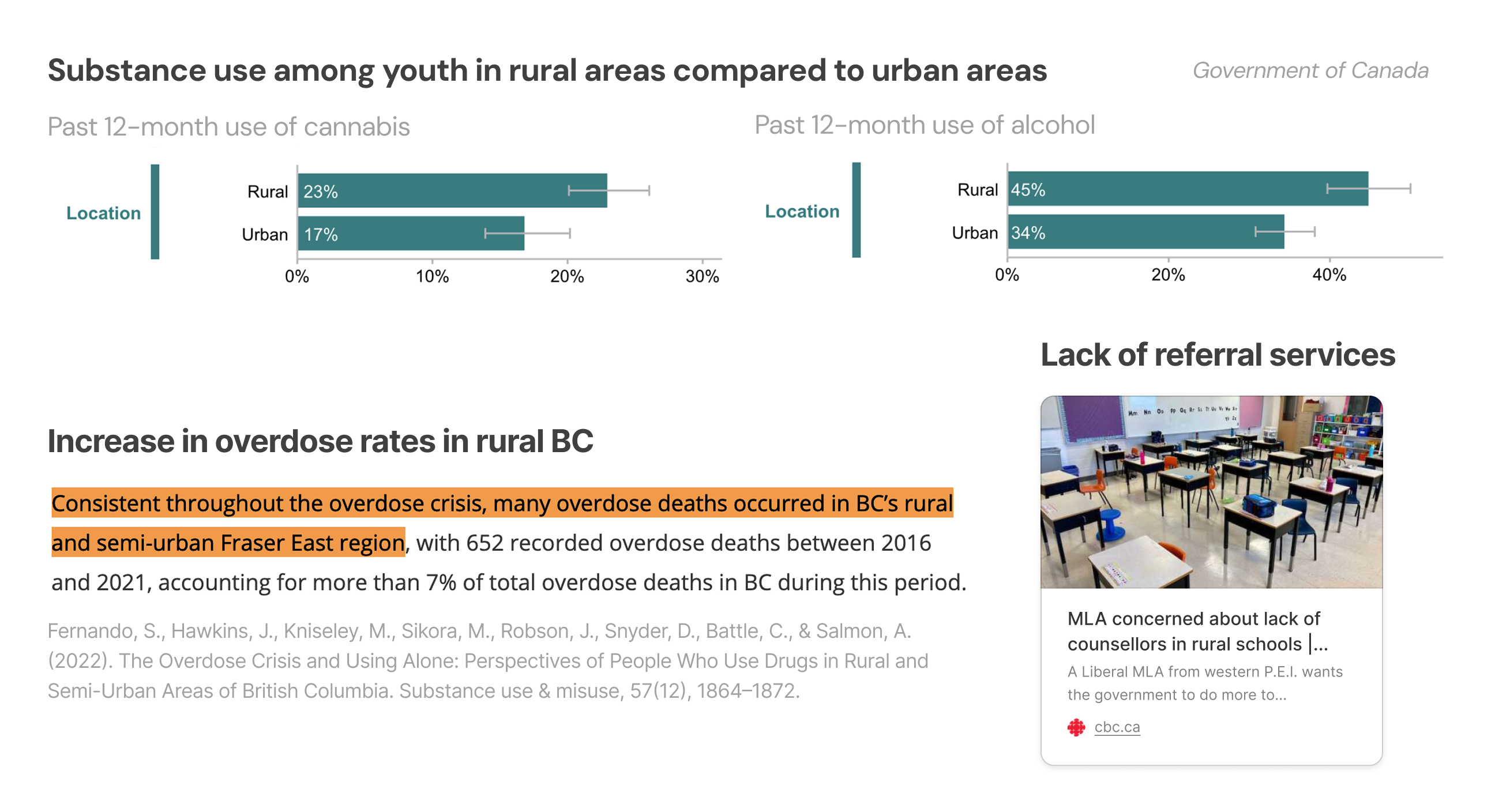
Rural youth in BC often face significant challenges when trying to access substance use support
Unlike urban areas, rural communities frequently lack nearby services, established youth support networks, and discreet pathways to help. This can lead to youth using substances alone and experiencing higher levels of risk.
Concept development for a youth-focused support application
After receiving positive feedback on our problem space, we moved into ideation to explore potential app concepts. As a team, we aligned on the importance of directly connecting rural youth struggling with substance use to professional support.
We initially considered several directions, including a storytelling-based app with anonymous professional guidance, a map-based interface for youth-specific services, and a skill-building app focused on coping strategies and light gamification. Through this process, we identified a key gap across existing solutions: youth are often expected to initiate contact and then wait without support.
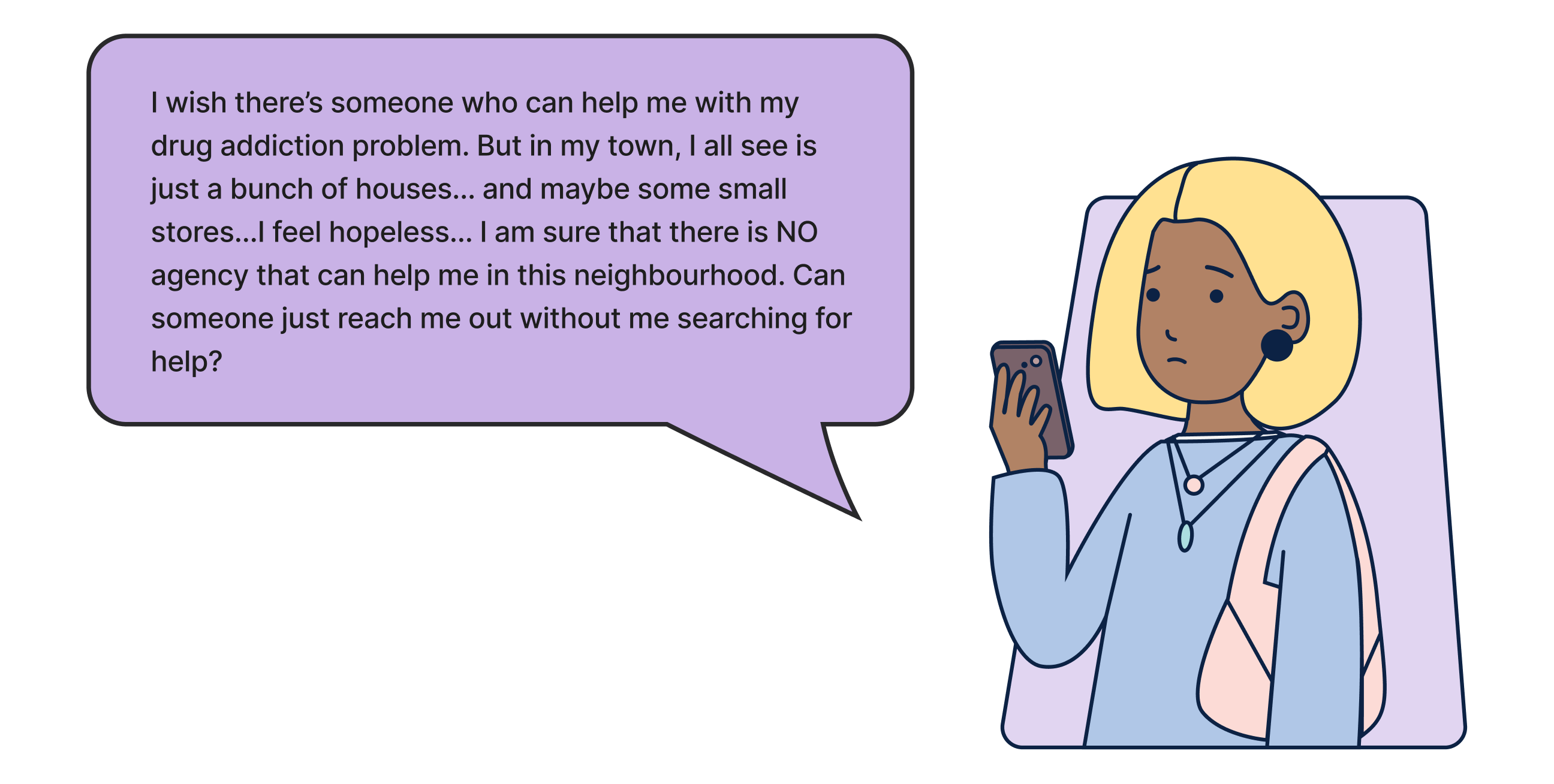
This insight led us to define two core objectives for our solution: first, to shift the communication dynamic by enabling service providers to reach out to youth, and second, to offer meaningful activities that support engagement while youth wait for human-to-human follow-up.
Seedling App
Based on these objectives, we came up with Seedling, an app with two core components:
- Connection to service providers. Youth can discover local organizations and opt into outreach, allowing providers to initiate contact and reducing the pressure on users to navigate complex systems alone.
- Gamification to sustain engagement. A location-based game allows users to collect “seeds,” discover community resources, and participate in shared virtual gardens while waiting for follow-up supporting emotional engagement.
Creating initial structure - user flows
I was responsible for creating two coordinated user flows for the onboarding questionnaire/service connection and game experience.
This ensured the app kept questionnaires and game separately as suggested by our teaching team. Thus, the users could move through structured onboarding and service connection, skip directly to play, or engage with the app gradually - without being forced into a single path.
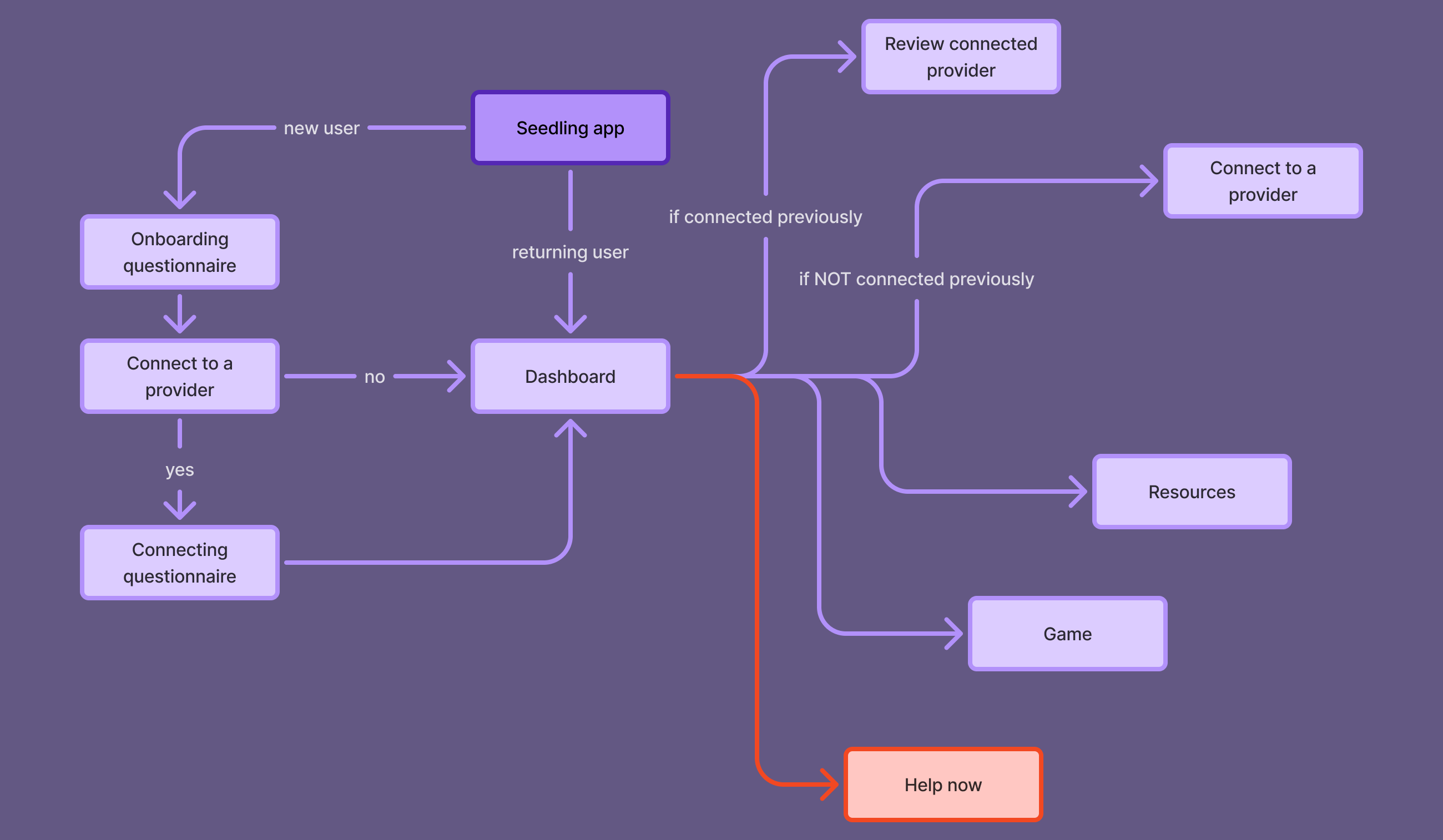
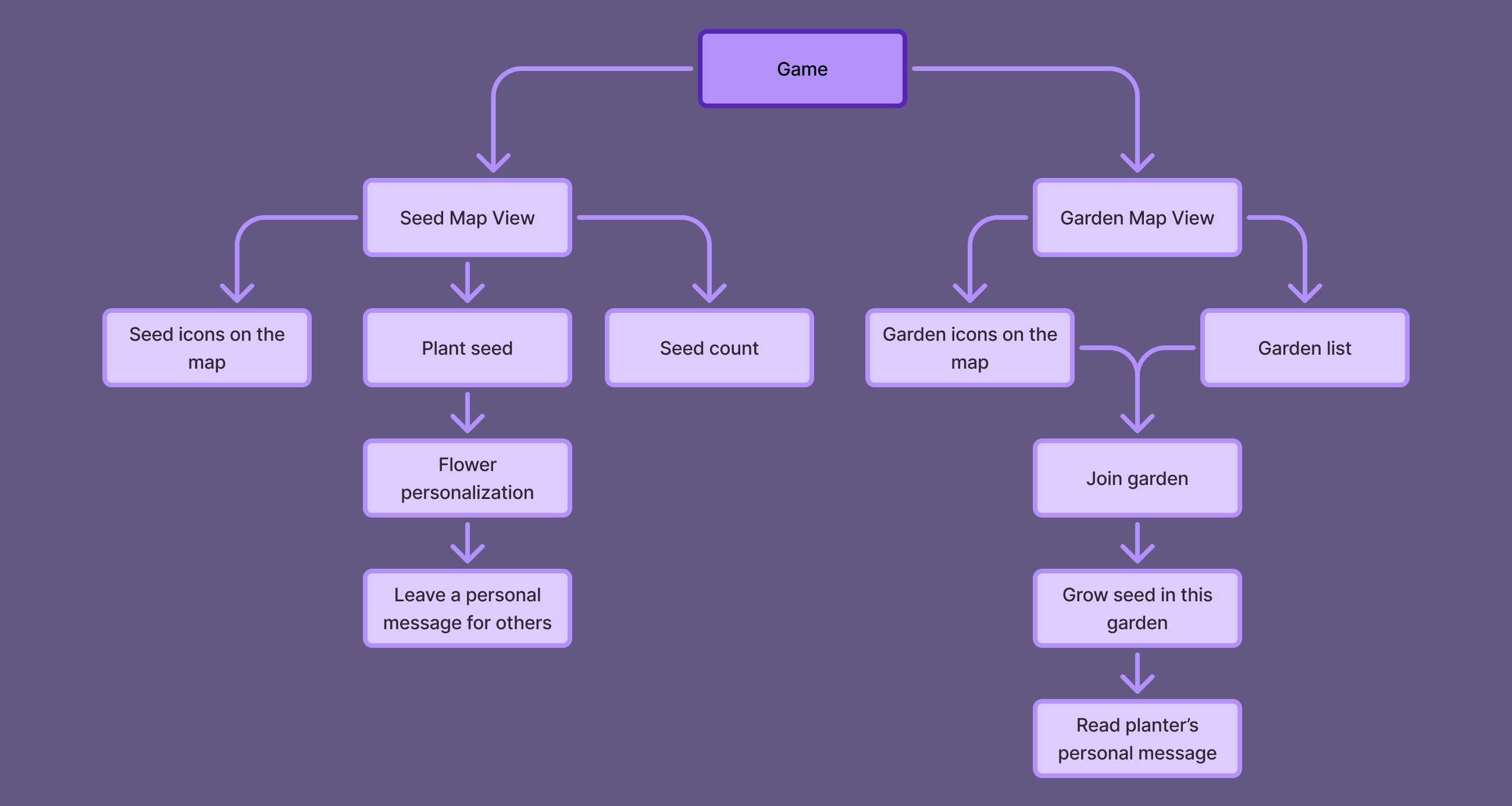
In other words, our application can be used differently depending on the user’s needs - whether they want to sign up for a service provider connection, play the game, or do both. We intentionally wanted to design the experience to feel relaxing and low-pressure, allowing users to engage at their own pace.
Collaborating on wireframes
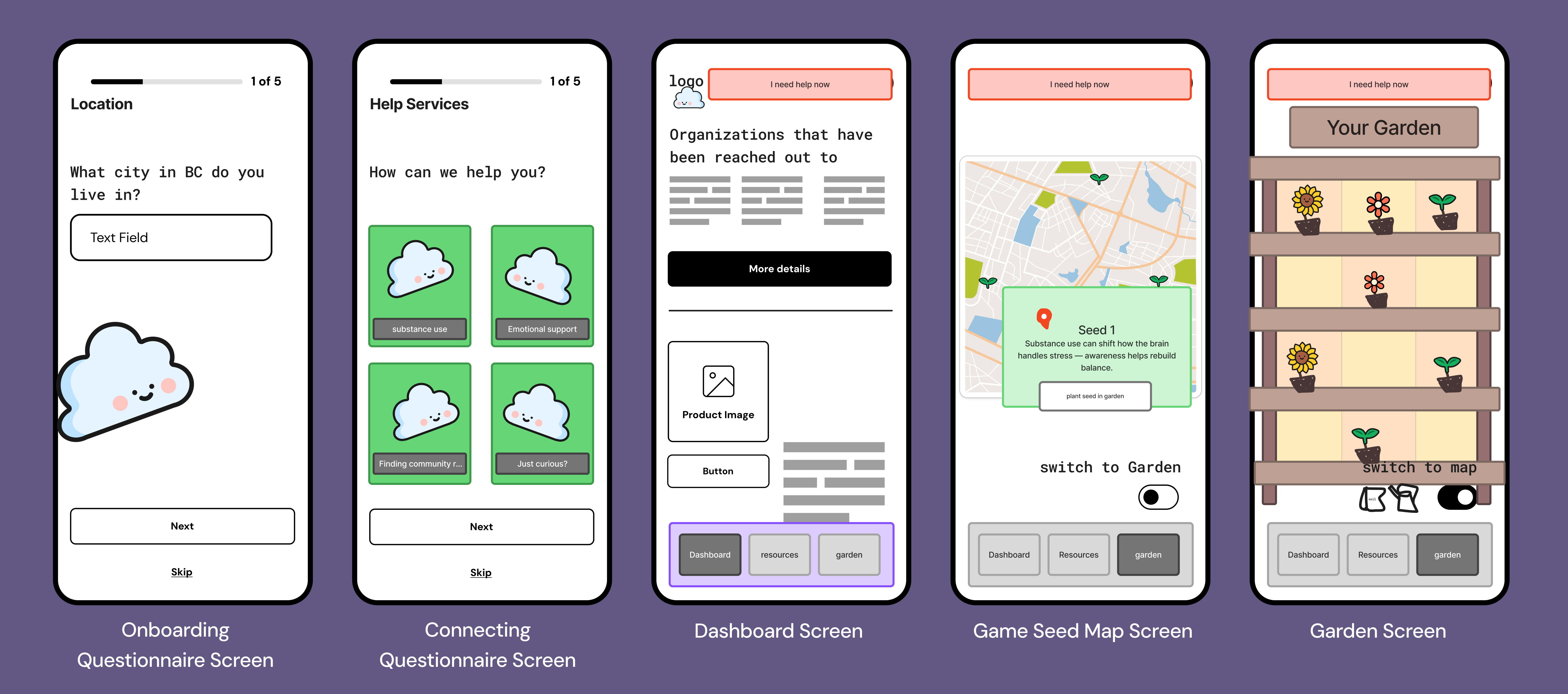
Wireframing was a collaborative effort across the team. Together, we explored layout, navigation, and information hierarchy for onboarding, dashboard, resources, emergency access, and the game. These wireframes established the foundation for later interaction refinement and visual direction.
Visual direction & mid-fidelity design
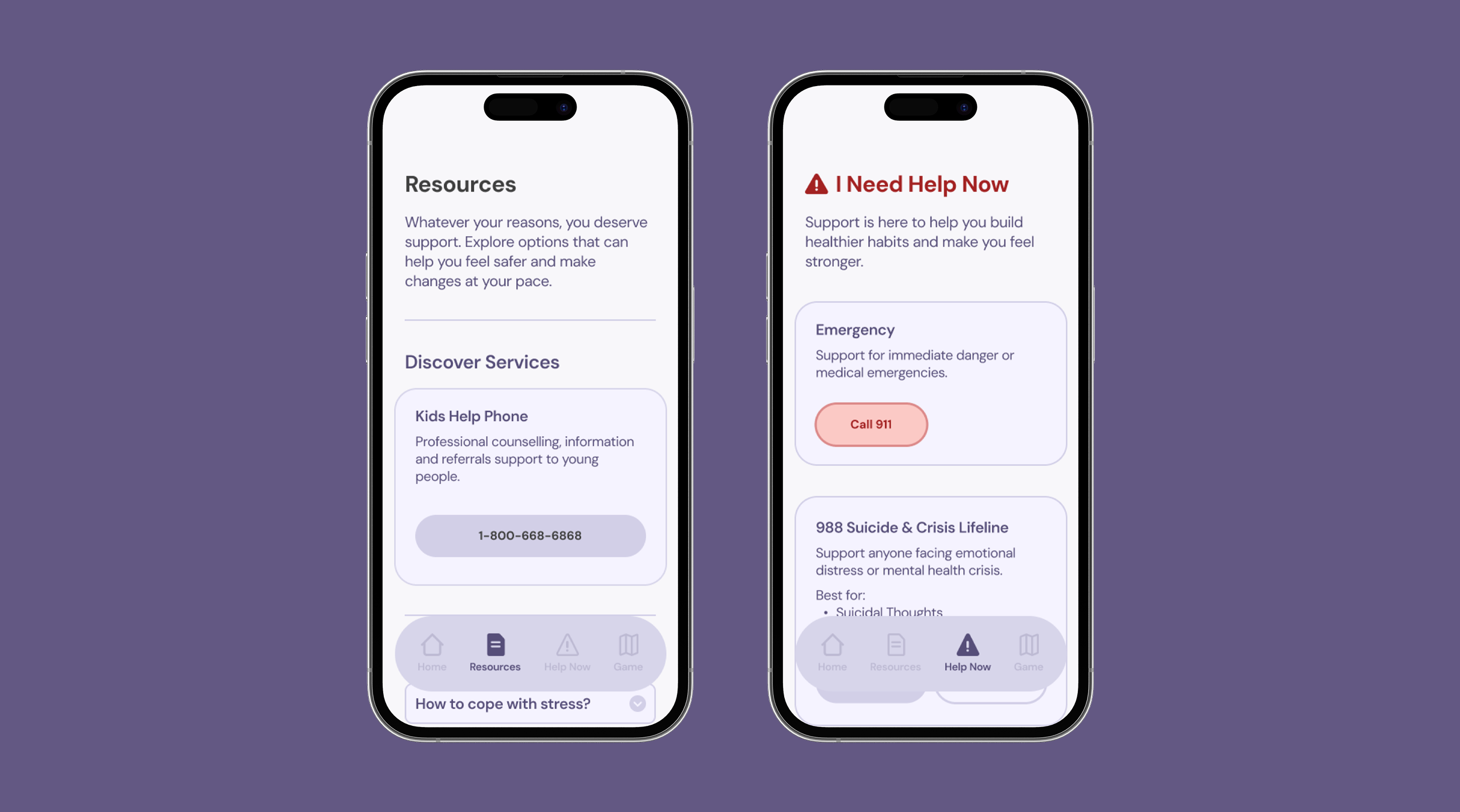
As we transitioned from wireframes to low- and mid-fidelity designs, I set the visual direction using calm purple tones to reduce anxiety and support emotional safety and designed our custom Seedling character, reinforcing growth and care.
I was particularly responsible for restructuring content and features to improve usability and reduce cognitive load. Some of the key UX improvements I introduced
- Drop-downs that minimize screen density while still allowing users to access all necessary content as needed
- A progress indicator that provides users with clear feedback on their progress
- Buttons to skip questionnaires, allowing users to engage solely with the game or dashboard if preferred
I conducted targeted research on the visibility of emergency actions in high-stress interfaces and recommended separating urgent support from non-urgent resources. As a result, I introduced a persistent “Help Now” button in the bottom navigation, ensuring immediate access to emergency support without requiring additional navigation or decision-making. This approach prioritizes user safety and aligns with best practices for high-risk contexts.
Iteration & design evolution
Initially, the game part of Seedling explored a personal garden where users collected seeds privately. However, the app did not strongly support Wave 2 (social interaction and collaboration) or Wave 3 HCI (user experience and value-driven engagement), as the experience remained isolated rather than communal.
According to Truong, and Gray (2022), community gardens foster a feeling of belonging which results in “social cohesion and community building” through cooperation and trust-building activities. Moreover, studies show that digital tools that allow participants to collaborate to improve their environment can enhance ‘place-belongingness’ - a sense of belonging associated with geographical places.
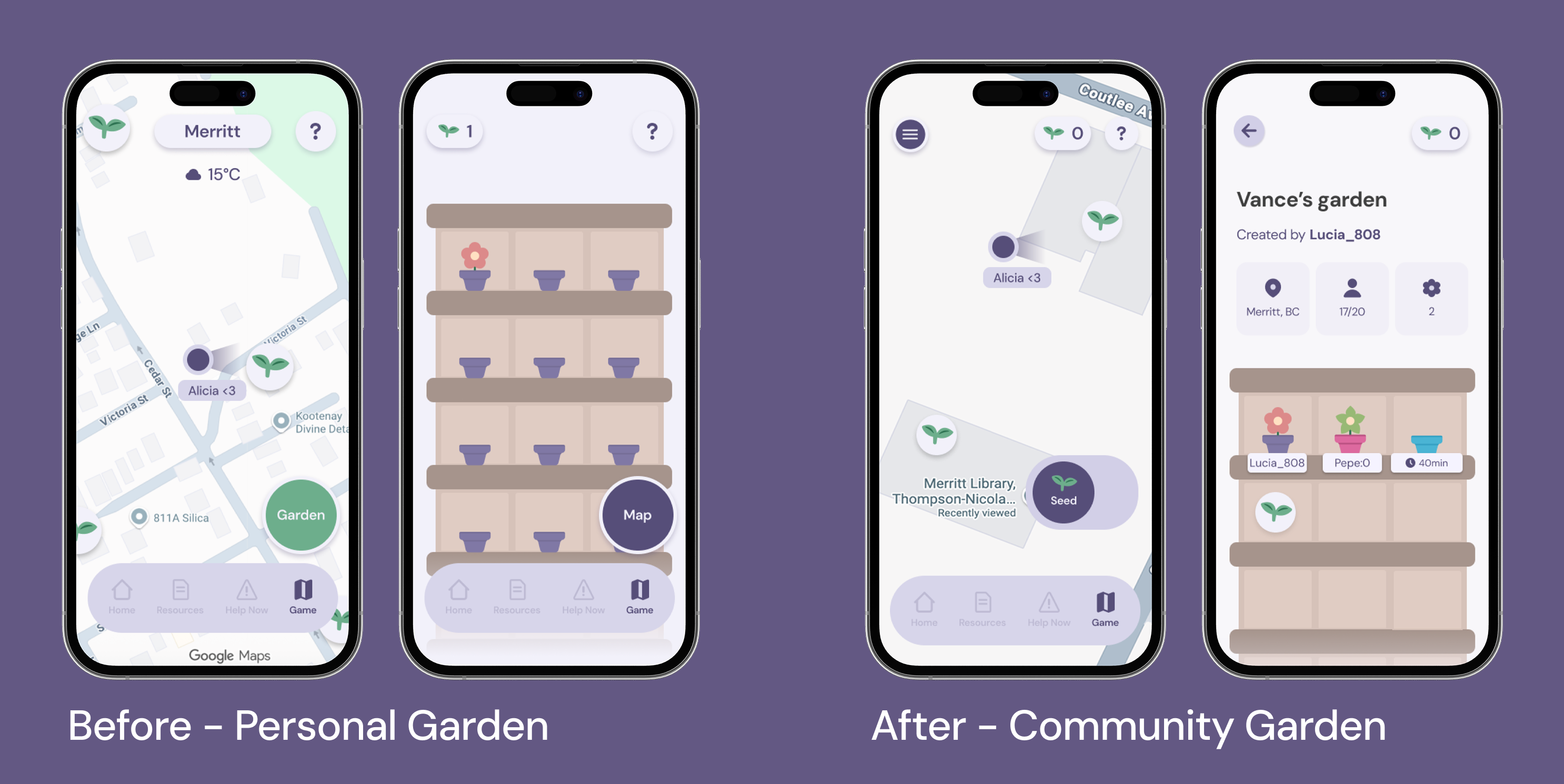
Through in-class critique and iteration, we shifted to a community garden model that emphasizes shared experiences and peer presence. Instead of individual gardens, users can now grow collected seeds in community gardens created by others.
Prototyping stage
I was involved in interactive prototyping process, particularly for the game and customization.
For game interactions, I separated seed and garden modes on the map using a custom toggle informed by user feedback. This distinction helps users clearly differentiate between community gardens available for interaction and the seed-collection screens within the game. I also added subtle shadow motion to seeds to signal collectability and implemented conditional logic with counters to ensure seed counts update accurately as users interact.
I designed the plant customization flow so that users first personalize the flower’s shape, colour, and pot, then review their selected design and add a personal message for others to unlock once the seed is collected by another user and begins growing in any community garden. This is followed by a confirmation screen that shows the seed’s placement on the map. Users cannot collect or view their own seeds, as planted seeds are intended exclusively for discovery by others.
This flow encourages intentional creation and reinforces the social nature of the experience. Separating customization, review and confirmation helps reduce cognitive load and allows users to feel confident in their choices before sharing them publicly.
I also prototyped the end-to-end community garden flow, allowing users to grow their seed, observe the growth process, and discover other users’ flowers and messages within the shared garden.
Final touches & design system
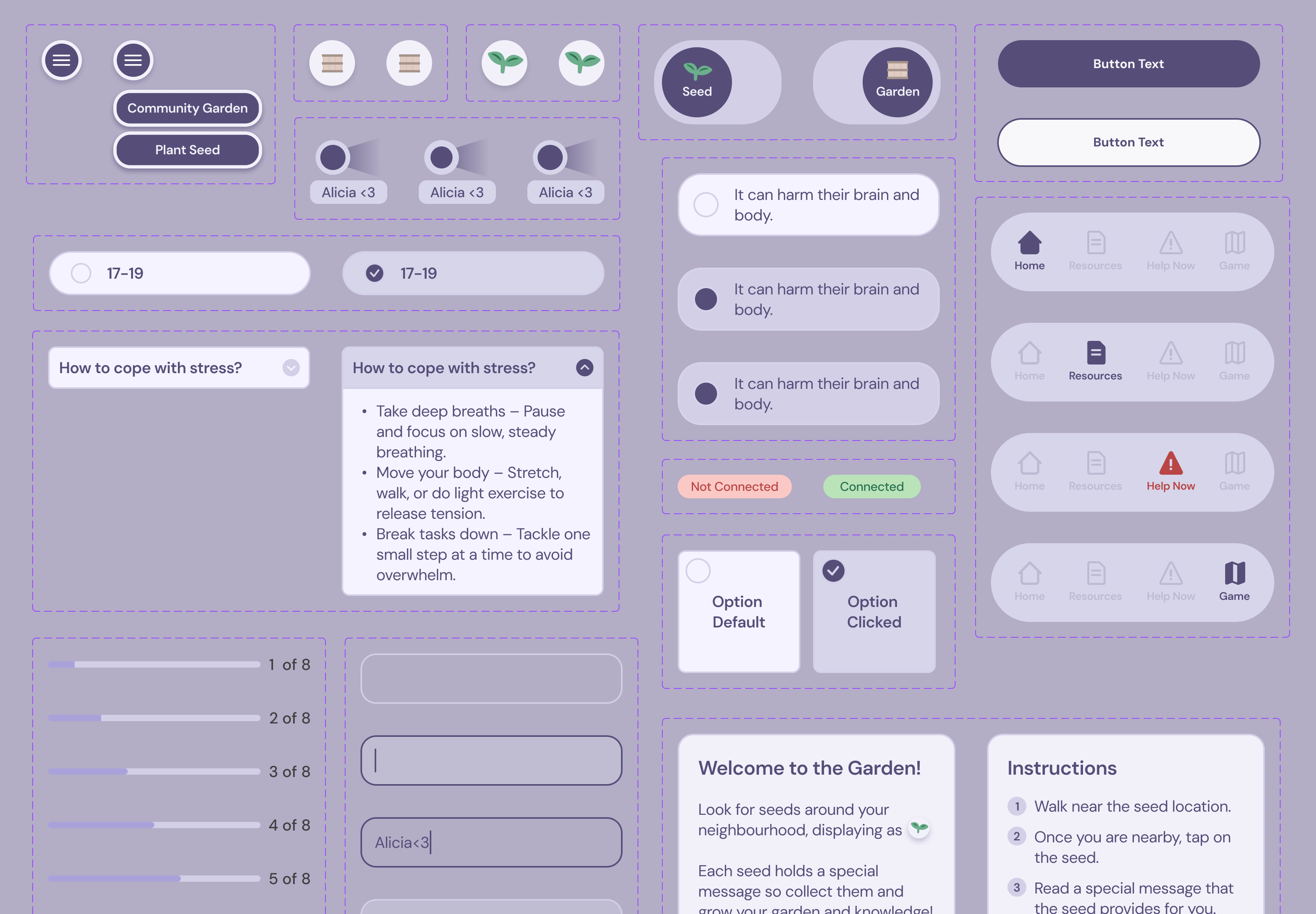
In the final phase, I collaborated with another teammate Kate to create reusable design system elements, ensuring consistency across screens, components, and interactions.
Reflection
This project strengthened my ability to design for emotionally sensitive, high-stakes contexts, balance individual autonomy with community-based experiences, and translate HCI theory into concrete interaction decisions. It also gave me end-to-end experience designing exclusively for mobile - from initial concept to final prototype - while developing my ability to allocate work effectively and leverage team members’ strengths.
If I were to redo this project, I would spend more time on visual and interaction consistency across screens, prioritizing a cohesive design system over adding secondary features that do not strongly support the core goal (such as watering seeds). I would also work more intentionally to tie interactions back to substance-use support, ensuring that every feature clearly serves the project’s primary purpose rather than diluting it.